SARAH'S LIFE
By V. C. Cheney
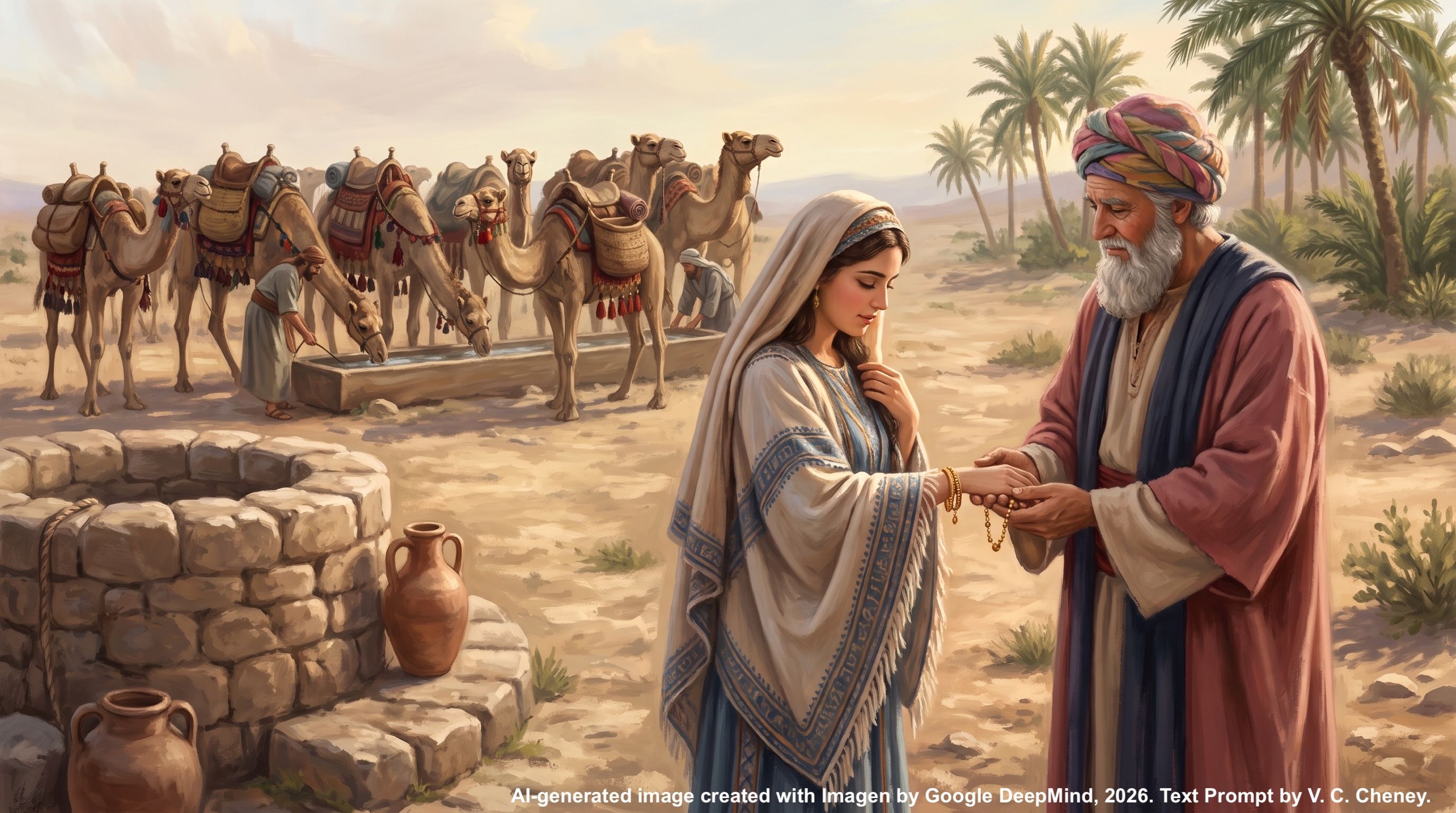
Abraham sends Eliezer to find a wife for Isaac from his relatives in the city of Nahor, Padan-Haran, Mesopotamia. Eliezer prays for a sign, which Rebekah fulfills, leading to her marriage to Isaac. This story exemplifies the first step in a marriage ceremony practiced in ancient Biblical culture. The origins of ancient marriage ceremonies and rituals are often overlooked, with many customs accepted without questioning their beginnings. Our contemporary wedding ceremonies trace their roots back to ancient Biblical wedding rites, as depicted in the stories of Isaac and Rebekah, of Jacob and Rachel, and of Ruth and Boaz.
The ancient marriage ceremony comprises approximately 14 steps, and the first step is the search for a bride. In ancient times, brides were selected by the bridegroom’s father. Young men seeking wives needed their fathers’ permission. Young women did not seek husbands; marriages were arranged by parents, and the bride-to-be usually met her new husband only on the wedding day. Dating and courtship were rare, and people disapproved of young single women being seen alone with young men. Over time, matchmakers and chaperones became involved in the process.
Abraham sent Eliezer, his most trusted and eldest servant, to find a bride for Isaac. Despite not inheriting everything Abraham owned before YHVH revealed his plan to have a son with Sarah, Eliezer was still trusted. The Hebrew word for “servant” is “eved” (עבד), similar to the Hebrew word “ivri” (עברי) for “Hebrew,” which is derived from the name Heber, one of Abraham’s ancestors. The Hebrew letters ב (beth) and ו (vav) are the same, and the Hebrew letter ר (rosh) resembles the Hebrew letter ד (dalet), creating a play on words. A Hebrew is a servant of YHVH, and vice versa. A true servant of YHVH is a Hebrew in every way, loving YHVH and his neighbors, and set apart by devotion. Are you a servant of God? If so, you are also a Hebrew, even if not by blood. A Hebrew shares some similarities with a Jew. The apostle Paul emphasized that being a Jew is not merely a matter of birth or circumcision. Instead, a Jew is someone whose heart is aligned with God. True circumcision is spiritual, occurring through the Spirit, rather than through the written code. Both Hebrews and Jews are individuals who maintain a close relationship with God.
Eliezer’s name means “My Elohim is my help,” and he successfully found a bride for Isaac with God's help. Eliezer was the first known “shadkhan,” or matchmaker. He represents the archetype of the earliest matchmaker, a role that has become widespread, inspiring numerous Jewish matchmaking books and dating websites. The movie “Fiddler on the Roof,” released on November 3, 1971, and adapted from the 1964 Broadway classic, features a Jewish matchmaker named Yente. The story centers on Tevye, a poor Jewish milkman in an early 20th-century Ukrainian village, who faces the challenge of preserving his traditions while raising his five strong-willed daughters amidst the looming threat of anti-Semitic persecution and forced displacement under Imperial Russian rule.
The ancient customs of the Hebrews symbolize Yeshua’s wedding to his believers, his Kahillah, the Bride. The Holy Spirit, similar to Eliezer, assists the Father in seeking, pursuing, and courting believers, aiming to make them fall in love with Yeshua. The story of Eliezer’s search parallels the Holy Spirit’s pursuit of new believers. Unlike the disciples who saw Yeshua in the flesh, most of us have not seen our Bridegroom. We await His arrival, like Rebekah, but learn to love because He loved us first.(John 15:16; 1 John 4:19; 1 Peter 1:8)
The Holy Spirit, akin to Eliezer the matchmaker, seeks a bride for YHVH’s Son. The Holy Spirit’s role is to attract potential believers to the Son. While many resist the Holy Spirit, others learn to listen and love the Son. This principle is illustrated by a parable: a king prepares a wedding banquet, and his servants, like Eliezer, go out to invite the guests. However, they refuse to attend, even when delicious oxen meat is served. Some seize and kill the servants, enraging the king. He destroys the murderers and their city. Then, he instructs his remaining servants to invite all people, good and bad, from the streets until the wedding hall is filled. (Matthew 22:2-12)
As marriage is a covenant with YHVH, understanding their origin reveals how our intimate relationship with Him develops and prepares us for the end times. How well prepared are you to meet your bridegroom Yeshua? Let’s study these wedding customs thoroughly as steps in our upward relationship with YHVH.
© 2026 Article by V. C. Cheney. All Rights Reserved.
This week, we are reading Parashah No. 5, Sarah's Life, חיי שרה
Torah: Genesis 23:1-25:18
Haftarah: 1 Kings 1:1–31
Brit Hadashah: Matthew 1:1–17
Image above: Eliezer search for a bride. Image below: Rebekah receives bridal gifts from Eliezer.